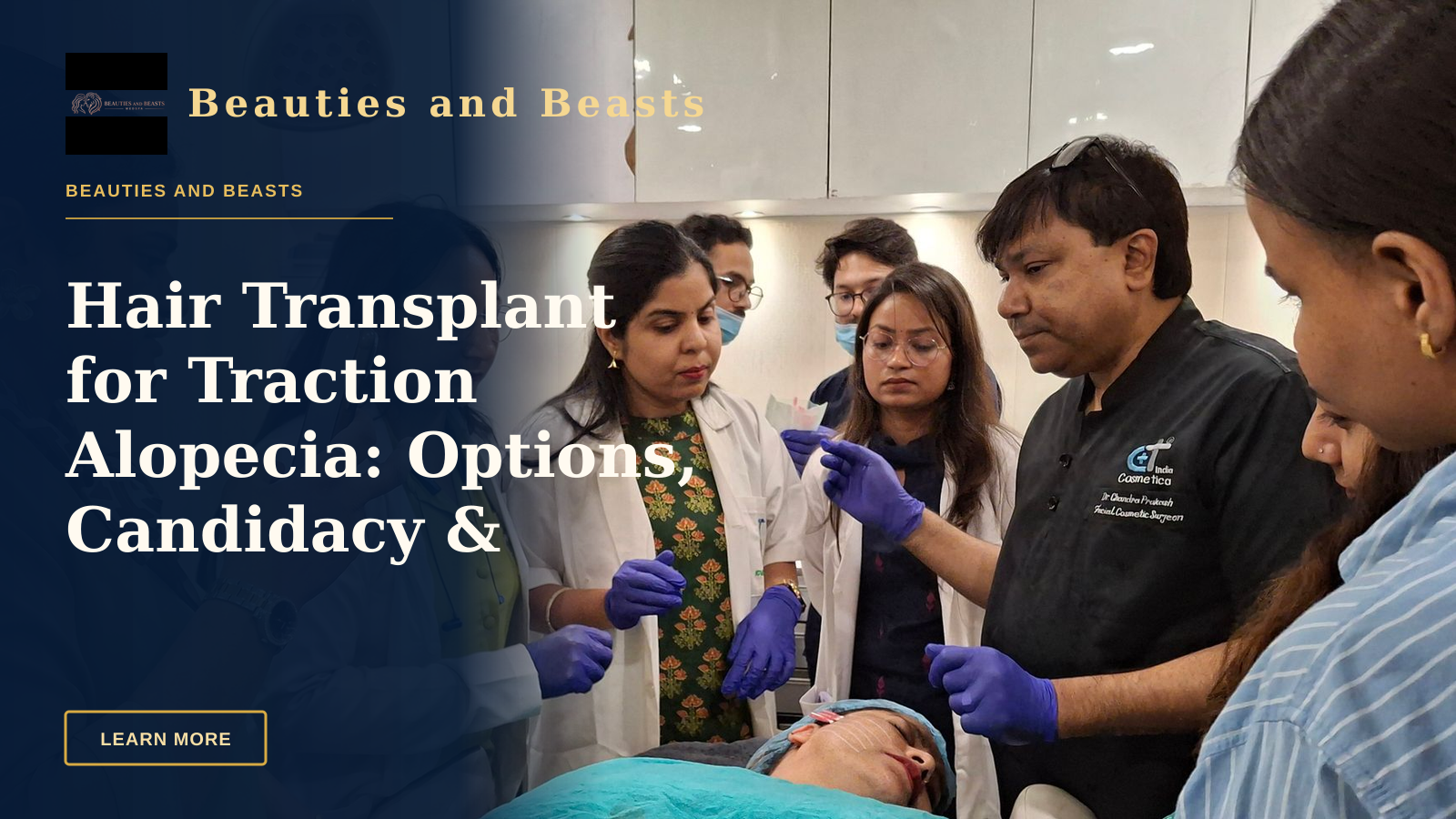
Considering a hair transplant for traction alopecia? Traction alopecia is hair loss caused by repeated tension on hair follicles (tight braids, extensions, or constant pulling). When follicles are permanently damaged, surgical hair restoration such as Follicular Unit Excision (FUE) or adjunctive therapies can be effective options — but candidacy, timing, and the combination of regenerative support matter.
At consultation we use objective diagnostics like FlowMediQ AI Facial Analysis and clinical scalp mapping to document donor viability and the pattern of traction loss, which helps guide whether a transplant, noninvasive regrowth therapy, or a combined approach is best. This article explains when a hair transplant for traction alopecia is appropriate, how the patient journey typically works, and practical next steps to evaluate options.
Patient Journey & Consultation
Beginning a conversation about hair transplant for traction alopecia starts with clear intake and diagnostics. Call (303) 933-8526 or use our Contact page to request a complimentary consultation; we also accept remote AI pre-scans using FlowMediQ to collect objective scalp and skin data before you arrive. That scan takes under two minutes and helps us triage candidates quickly.
In clinic we review medical history, examine donor and recipient areas, and explain available options (surgical FUE, noninvasive InFuze TED, PRF regenerative support, or combined plans). Treatment timelines and expected appointment durations are shared so you can plan — many consults include immediate unit/graft estimates, a discussion of financing, and a mutually agreed next step.
Typical steps in our patient pathway for traction alopecia are designed to be transparent and evidence-based:
- Objective pre-scan and photo documentation (FlowMediQ scans and standard photos).
- Complimentary consultation to review candidacy, donor availability, and options.
- Custom treatment plan with timelines, expected procedure duration, and financing/aftercare details.
- Follow-up and long-term monitoring using repeat imaging and periodic check-ins.
We emphasize a conservative, staged approach for traction alopecia because the underlying cause must be corrected (stop the traction) before expecting predictable graft survival and regrowth. For convenience you can request a consult through our online booking system and start with the AI pre-scan: online booking.
Beauty & Wellness, Right at Your Fingertips
Download the Beauties and Beasts App and start earning, saving, and feeling your best.
Get more from your Beauties and Beasts experience with our app. Earn rewards with every visit, discover personalized treatment recommendations, schedule appointments, shop your favorite products and services, and enjoy exclusive discounts and special offers available right in the app.
Click to get $50 off your first purchase!Understanding Traction Alopecia: When a Transplant Makes Sense
Traction alopecia initially causes temporary shedding, but prolonged traction can produce permanent follicular scarring. The key clinical question is whether the affected follicles are irreversibly lost. If miniaturization can be reversed by stopping traction and using medical or device-based regrowth strategies, a surgical transplant may not be immediately necessary.
Indicators that a hair transplant is a reasonable next step include stable, well-defined areas of permanent loss and a healthy donor zone with sufficient graft supply. We evaluate donor density, hair caliber, scalp laxity, and the history of styling behaviors that caused the problem.
- Early-stage traction alopecia: prioritize withdrawal of traction, topical treatments, and noninvasive devices (InFuze TED, PRF) to recover miniaturized follicles.
- Established, scarred zones: consider FUE transplantation when donor supply and scalp health are adequate.
- Mixed cases: combine regenerative therapies (PRF, MSC Exosomes) with limited grafting to improve outcomes and minimize graft needs.
A qualified clinician will provide a photo-documented plan that may combine non-surgical and surgical modalities; use diagnostic tools like FlowMediQ and in-clinic scalp mapping to track progress and make decisions. For a deeper look at non-surgical pathways, see our Hair Regrowth Restoration information: Hair Regrowth Restoration.

Ready to take the next step?
Book a Free ConsultationServices & Procedures
Our integrated med-spa + wellness menu pairs aesthetic procedures with medical programs and regenerative therapies to address both the cause and the effect of traction alopecia. Below is our complete, enumerated treatment menu with practical timing notes so you know what to expect during consultation and treatment planning.
- FlowMediQ AI Facial Analysis (in‑clinic skin mapping)
- Complimentary consultations (in person or via AI Skin Analysis)
- Cosmetic neurotoxin injections: Botox® injections
- Cosmetic neurotoxin injections: Dysport® injections
- Cosmetic neurotoxin injections: Jeuveau® injections
- Cosmetic neurotoxin injections: Letybo® injections
- Neurotoxin procedures for aesthetic/functional uses (brow lift, lip flip, jaw slimming, masseter treatments, hyperhidrosis)
- Dermal fillers (FDA‑approved HA fillers using Juvéderm® and Restylane®)
- Lip enhancement (dermal filler)
- Cheek augmentation (dermal filler)
- Jawline & chin contouring (dermal filler)
- Under‑eye (tear trough) filler
- Nasolabial fold treatment (dermal filler)
- Marionette line treatment (dermal filler)
- PRF Treatments: facial PRF injections
- PRF microneedling facials
- PRF for hair restoration (scalp PRF)
- PRF joint injections
- MSC Exosomes regenerative therapies
- Sexual wellness PRF shots: He‑Shot (men)
- Sexual wellness PRF shots: V‑Shot (women)
- FUE (Follicular Unit Excision) hair transplantation
- InFuze TED noninvasive hair regrowth therapy
- Custom medical‑grade facials (45–60 minutes)
- Mini express facials (25 minutes)
- LMNT Red/Infrared LED light therapy (adjunct to facials)
- Chemical peels (VI Chemical Peels — Purify, Precision + peptides)
- RF microneedling (including Colibri technology for delicate areas)
- Alma Opus Colibri treatments
- Alma Opus Plasma (Opus Plasma) advanced plasma resurfacing
- ClearLift (Harmony® XL PRO by Alma® fractional laser) — <30 minutes
- Dye‑VL photofacials (IPL)
- Tattoo & PMU removal (Dye‑VL and Li‑FT® saline removal)
- Laser skin resurfacing
- Pigmentation correction (laser/IPL protocols)
- Vascular lesion treatments
- Laser hair removal (Harmony XL PRO referenced)
- Body contouring: T‑Shape 2 sculpting system
- Body contouring: TruBody non‑invasive sculpting
- truSculpt treatments
- truFlex treatments
- PDO thread lifts and meshing techniques
- Sclerotherapy for spider veins
- Spider vein treatments (DYE‑VL and sclerotherapy)
- IV Nutrition & Hydration: B‑Lean, Recovery & Performance, Immunity, High‑Altitude
- IV add‑ons and injections: L‑Glutathione, MICC Lipo + B12, IM injections
- Hormone replacement therapy (BHTRT)
- Medically supervised weight loss programs including GLP‑1 peptide therapy
- Medical‑grade skincare and customized skincare regimens
- Acne treatments (DYE‑VL, ClearLift, Opus Plasma, RF microneedling, Hydrofacials)
- Lash & brow services: lash lifts, lash tints, brow tints, brow lamination, waxing
- Tattoo & Permanent Makeup (PMU) removal services
- Complimentary two‑week neurotoxin follow‑up and routine aftercare guidance
- Patient financing options and Beauties & Beasts Rewards App loyalty program
Operational timing and typical durations we follow: FlowMediQ scans take under two minutes, neurotoxin appointments are typically 15–20 minutes with onset in 3–7 days and full effect at ~2 weeks, ClearLift sessions are under 30 minutes, and custom facials run 45–60 minutes (mini 25 minutes). We pair diagnostics with procedure‑level timelines during every consultation so you know what to expect.
- Integrated care means we can pair FUE with PRF/Exosomes or start with noninvasive InFuze TED to reduce graft needs.
- Complimentary consultations with objective FlowMediQ scans speed decision-making and planning.
- Transparent timelines and routine follow-up (including a complimentary two‑week neurotoxin check for other services) are standard.
For a full list of services and to schedule a consult, visit our services page: Explore our services. Quick links for treatment-specific information: Dermal Fillers, Botox in Littleton, CO, FUE Hair Transplants — Ken Caryl, Custom Facials and Dermaplaning.
A Complete Approach to Beauty & Wellness
Explore Our Services
We believe beauty and wellness are interconnected, which is why we offer a comprehensive range of aesthetic, wellness, body contouring, and hair restoration services under one roof. From skin rejuvenation and injectables to hormone therapy, weight management, IV therapy, and hair restoration, our approach allows us to create personalized treatment plans based on each client's unique goals—not a one-size-fits-all solution.
Explore Our ServicesSurgical and Non‑Surgical Options for Traction Alopecia
When permanent follicle loss is present, a surgical FUE hair transplant is often the most direct way to restore density to affected areas. FUE transplants harvest individual follicular units from a healthy donor zone and implant them into scarred or denuded regions. Because traction alopecia commonly affects the frontal and temporal hairline, careful hairline design and graft placement are essential to a natural result.
Non-surgical options can be appropriate either as first-line therapy or adjuncts to surgery. InFuze TED (acoustic regrowth therapy) stimulates follicles without needles and can be used to improve density in salvageable areas. Autologous PRF (scalp PRF) and MSC Exosomes support tissue health and are commonly combined with device therapy to maximize regrowth and graft survival.
- FUE (surgical) — best for clearly scarred/absent areas with adequate donor supply.
- InFuze TED & topical/medical therapy — useful for early or mixed cases and in combination with PRF.
- Staged approaches (regenerative first, then selective FUE) reduce the number of grafts needed and improve aesthetic integration.
For surgical technique references and local surgical partners who specialize in FUE, see external clinical resources such as FUEsion Hair Clinics - Denver. If you’re considering a female-specific approach, review our Female Hair Transplant information: Female Hair Transplant and the non-surgical options at Hair Regrowth Restoration.
Want personalized advice?
Schedule Your AssessmentTechnology & Technique
Delivering predictable hair transplant outcomes for traction alopecia requires precise diagnostics and a matched device portfolio. We deploy objective tools and select platforms so each treatment is titrated to your anatomy and goals. FlowMediQ AI Facial Analysis supports scalp documentation and treatment selection in under two minutes.
Our in-clinic technology mix includes fractional lasers, RF microneedling, plasma resurfacing, acoustic hair regrowth devices, and in-house biologics to support graft survival and recipient scalp quality. Using these platforms together lets us treat texture, vascularity, and the microenvironment that supports transplanted follicles.
- Pre-procedure mapping with FlowMediQ to document baseline and enable progress tracking.
- Use of InFuze TED and PRF to optimize scalp health before and after grafting.
- Careful surgical technique (FUE) combined with regenerative adjuncts to improve integration and reduce the need for large graft counts.
The specific device inventory we use includes: FlowMediQ AI Facial Analysis; Harmony® XL PRO / ClearLift; DYE‑VL; LMNT Red/Infrared LED; Alma Opus Colibri; Alma Opus Plasma; InFuze TED; T‑Shape 2; TruBody / truSculpt / truFlex; Li‑FT®; Juvéderm® & Evolysse®; Botox®, Dysport®, Jeuveau®, Letybo®; and PRF & MSC Exosomes. Each platform is chosen so we can titrate energy depth, biologic stimulus, and placement for individualized plans. Learn more about our services: our services.
Beauty Has Its Rewards
Get the App
Download our rewards app, earn points, unlock exclusive perks, and get rewarded for taking care of yourself.
Get the AppEvaluating Results & Managing Expectations
Realistic expectations are central to satisfaction with any hair restoration plan. Transplanted hair typically begins visible growth at 3–4 months and continues maturing over 12–18 months. When traction alopecia is accompanied by scarring, overall density may be limited by donor supply and recipient tissue quality; combining grafting with PRF or Exosomes can improve outcomes but does not guarantee full density restoration.
We document baseline photos, perform FlowMediQ-based progress scans, and schedule routine follow-up visits to monitor graft survival and scalp health. If non-surgical devices are used, progress is typically evaluated in 8–12 week cycles and documented objectively to guide next steps.
- Growth timeline: initial shedding (first weeks), early regrowth 3–4 months, meaningful density by 9–12 months.
- Follow-up imaging with FlowMediQ helps quantify improvement and determine maintenance intervals.
- We provide written aftercare and schedule routine check-ins to address healing, hair care, and adjunct therapies.
Before committing to surgery, ask for documented before-and-after examples for traction alopecia cases and a clear written plan for staged or combined therapy. You can review our Gallery and procedural articles for examples: View our Gallery and Read patient stories & articles.
See how we can help you
Get Started TodayConclusion
Hair transplant for traction alopecia can be an effective solution when loss is permanent and donor supply is adequate, but the best outcomes rely on correct diagnosis, eliminating the source of traction, and a tailored plan that may combine surgical grafting with regenerative and device-based support. Diagnostics such as FlowMediQ AI scans, in-clinic scalp mapping, and staged use of PRF or InFuze TED improve decision-making and can increase the predictability of results.
If you suspect traction alopecia, the practical next step is a no-cost consultation where your scalp is documented and options are mapped to your goals. We’ll review candidacy, graft estimates, timelines, and financing so you can make an informed choice. Start with a complimentary consult or an AI pre-scan to jump-start planning.
To schedule a consultation or request an AI pre-scan, use our online booking portal or call the clinic; if you prefer to research first, review our services and hair-specific pages linked in this article.
FAQ
- Is a hair transplant the best option for traction alopecia?
- Not always. If follicles are still viable, non-surgical treatments (InFuze TED, PRF, topical/medical therapy) may restore hair without surgery. Surgery is considered when loss is permanent and the donor zone can supply sufficient grafts.
- How long until I see results after a transplant?
- Expect early regrowth around 3–4 months and progressive improvement up to 12–18 months. Regenerative adjuncts and careful aftercare can influence the speed and quality of regrowth.
- Can PRF help with traction alopecia?
- PRF (scalp PRF) is commonly used to improve the scalp environment and support regrowth; it can be helpful as a stand-alone or adjunct to FUE, particularly when combined with devices like InFuze TED.
Locations & Access
We are a single full-service clinic located in Ken Caryl (Littleton), serving the southwest Denver metro area. Our front desk can help schedule complimentary consultations, accept AI pre-scans, and provide pre-visit instructions and financing information.
- Clinic address — 10354 W. Chatfield Ave, Suite 203, Littleton, CO 80127
- Phone — (303) 933‑8526
- Email — [email protected]
- Hours — Mon–Fri: 9:00 AM – 5:00 PM; Sat: By Appointment Only; Sun: Closed
- Virtual & AI access — complimentary consultations in person or via FlowMediQ AI pre-scans (remote photo/scan workflows available).
- Booking & contact — call or use our Contact page to request appointments, pre‑visit forms, or financing information: Contact Us.
We aim to make access seamless: book a complimentary consult, upload photos for an AI pre‑scan, or call for a same‑week appointment when available. Every patient receives a personalized plan, clear pre/post instructions, and routine monitoring to document results.
Next Step
Locations & Access
Discover how our team can help you take the next step with confidence.
Contact UsMedical Information Disclaimer
This content is provided for general educational purposes only. It is not a substitute for professional advice, diagnosis, or treatment. Readers are advised to consult qualified professionals for personalized recommendations.
Have questions? We have answers.
Speak With an Expert